Showing posts with label William Armitage (1841-1926). Show all posts

Tuesday, 17 July 2018

Finding the Grave of William Armitage (1841-1926)

This blog contains an item on the life of William Armitage (1841-1926) a soldier, who later became a gate keeper in Kensington Palace Gardens. The website Deceased Online lists a burial at Kensal Green Cemetery which seemed likely to be his. The burial register gave the grave number as 48425 and I decided to visit the cemetery to look for the grave.

The following information comes from the website of The Friends of Kensal Green:

The General Cemetery of All Souls, Kensal Green, is one of England's oldest and most beautiful public burial grounds, and certainly its most prestigious. One of the world's first garden cemeteries, and doyen of London's Magnificent Seven, Kensal Green received its first funeral in January 1833, and still conducts burials and cremations daily. The cemetery was innovative in having most of the site consecrated by the Church of England, but reserving the eastern spur for Dissenters and others to practise their own rites. Today, people of many faiths and denominations are buried throughout the cemetery. Uniquely among British cemeteries, Kensal Green has been managed by the same private joint-stock company since its inception: the General Cemetery Company (est. 1830) still has its offices by the Main Gate. The cemetery now covers some 72 acres (29 hectares) between the Grand Union Canal and Harrow Road in west London, and is open to visitors every day of the year.

Many famous people are buried in the cemetery. Its notable personalities include some 650 members of the titled nobility and over 550 individuals noted in the Dictionary of National Biography. Kensal Green is the resting place of the engineers Sir Marc Isambard Brunel and Isambard Kingdom Brunel, the mathematician Charles Babbage, and the novelists Wilkie Collins, Anthony Trollope and William Makepeace Thackeray; Lord Byron's wife, Oscar Wilde's mother, Charles Dickens' in-laws and Winston Churchill's daughter; a cross-dressing Army doctor and the surgeon who attended Nelson at Trafalgar; the creator of Pears' Soap, and the original WH Smith; the funambulist Blondin and the Savoyard George Grossmith; the first man to cross Australia from south to north; and the last man to fight a duel in England.

The graves are not arranged in order of their numbers, so I visited the cemetery office to ask where grave 48425 is located. The man there was very helpful. He looked up the grave in the cemetery register. The entry showed that the burial rights were purchased on 9 July 1926 for £10:10 by Ellen Elizabeth Armitage of 225 Cornwall Road, Notting Hill. This was the name of William Armitage’s daughter, thus confirming that the grave was that of my relative. The burial took place on 12 July 1926. A monument, described as “marble kerbs on concrete ledge” was place on the grave on 24 March 1927. Grave 48425 is in Square 123, Row 4. The entry showed that no other people are buried in this grave.

The man in the office gave me a cemetery map showing the location of square 123 and directions on how to get there. He explained that newer graves in the cemetery often have a code on them such as 65234.110.2, which corresponds to the grave number.square.row. This is helpful in locating the square that you are looking for. He also gave me a detailed plan showing the positions of graves within square 123, with the surnames of those buried in them.
Cemetery map


Plan showing graves within square 123

The cemetery is large so it took me a while to walk to square 123. I was able to locate William’s grave by comparing the names on gravestones with those on my detailed plan. William was not a wealthy man, so I was not surprised to find that his grave monument is a simple one. It is inscribed “WILLIAM ARMITAGE died 7th July 1926 aged 85”.

Grave inscription
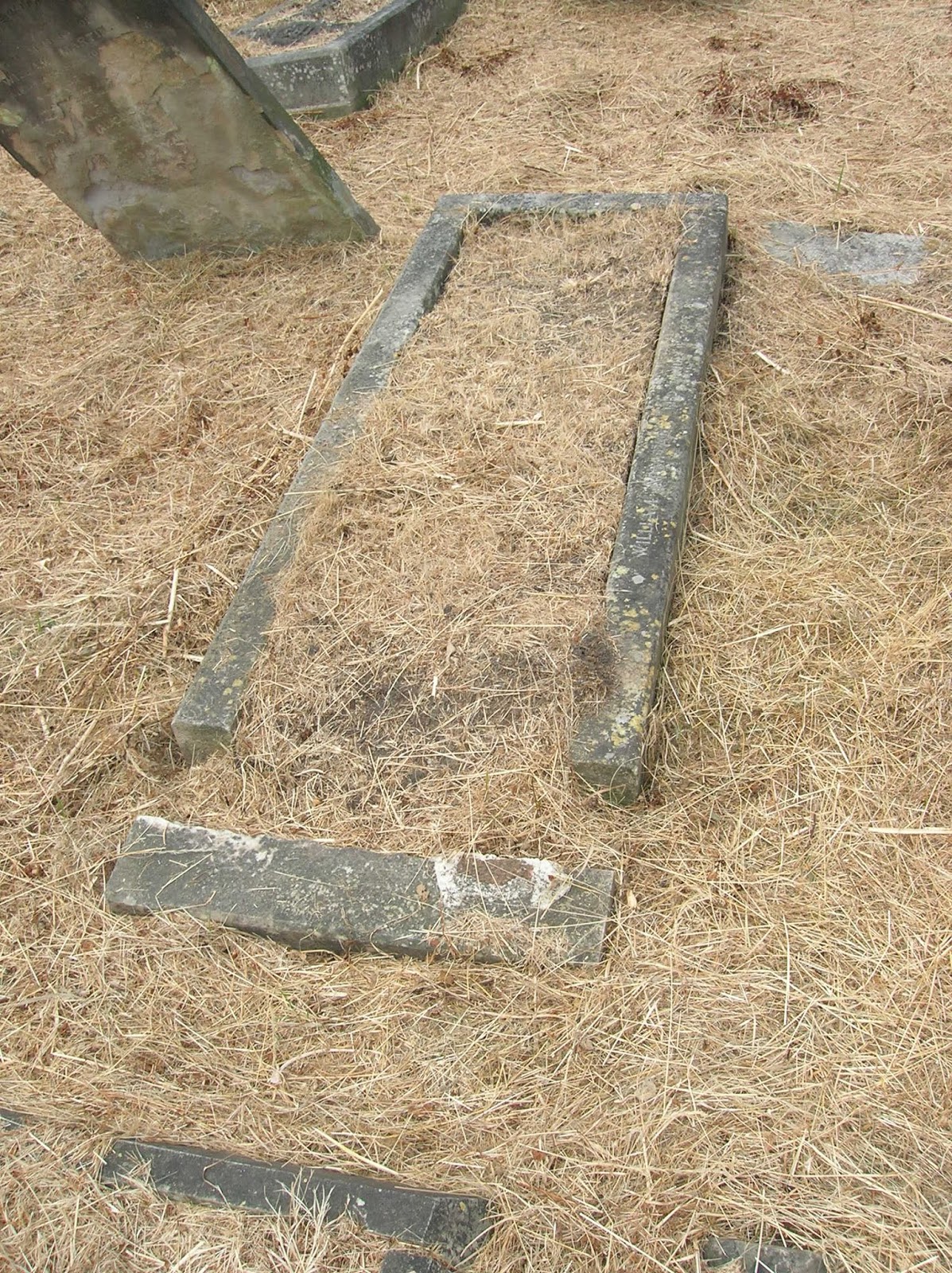
William’s grave
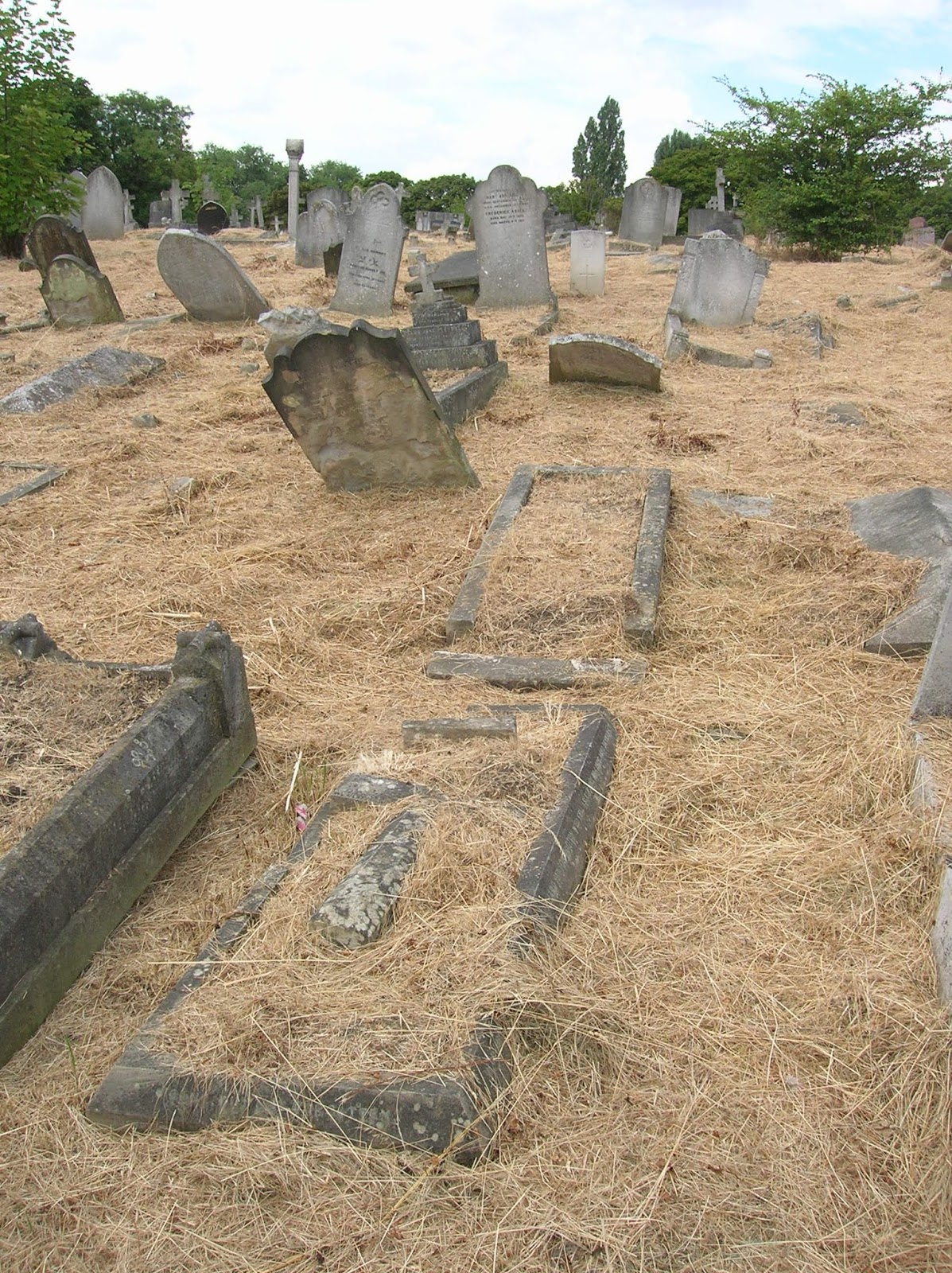
William’s grave and those around it.

Friday, 1 June 2012

William Armitage (1841-1926), soldier and gatekeeper

William Armitage was an elder brother of Robert Melton Armitage (1846-1910), my great grandfather.

William was born 1841 in Leeds, the third of five boys born to Thomas Armitage (a linen maker) and his wife Elizabeth (nee Woodward), who died about 1850. The 1851 census shows Thomas Armitage, a widower aged 46, living at 4 Pendulum Street, Leeds with his sons William (aged 9), Joseph (6) and Robert (3).

William joined the army on 27 June 1861 in Leeds. He gave his age as 20 years and his previous occupation as miner. He was unmarried, height 5 foot 7 inches, 157 lbs, with brown hair and tattoos on both arms. He enlisted for 12 years for a bounty of one pound, joining the Royal Artillery. The signature box on the enlistment form contains “the mark of William Armitage“, indicating that he was illiterate. William was in the UK until 11 July 1862 when he was posted to India, where he served until 5 Aug 1867. The Indian Army was formed by the British Government after the Indian Mutiny in 1857 (before then the British East India Company had its own army units). The Indian Army was used to suppress uprisings, keep order and guard the frontiers. It included British and Indian (sepoy) units.

On his return to the UK, William was posted to Woolwich then Dover where he married Kate Marton (born 1847 in Pimlico, Middlesex) on 23 September 1869. He was aged 28 and she 22. They went on to have six children namely Robert Henry (b 1870 in Dover), Thomas William (b 1871 in Limerick), Robert Melton (b 1874 in Woolwich), Ellen Elizabeth (b 1878 in Colchester), John James (b 1881 in Colchester) and Joseph Edward (b 1883 in Battersea). The places of birth of his first five children show where William was posted.

Thomas William Armitage was baptised in 1873 and Robert Melton in 1874, both at St Mary Magdalene church in Woolwich. Their father William is listed in the baptism record as a Gunner, 17 Brigade, Royal Artillery.

The 1881 census shows William (aged 40, a soldier), Kate (33), Robert Henry (9), Thomas William (7), Robert Melton (6) and Ellen (2) Armitage living at Artillery Barracks, St Giles, Colchester. William’s occupation is given as “Gunner, Royal Artillery” on the birth certificate of his son John James in May 1881.

In 1881, Egyptian army officers led by Ahmed Arabi mutinied against the Khedive of Egypt and forced him to appoint a nationalist government. In January 1882  Arabi became Minister of War and demanded that foreigners be driven out of Egypt. Britain was concerned about access to the Suez Canal and their investments in Egypt. This prompted an armed British response, first in the form of a naval bombardment of Alexandria, and then an expeditionary force under Lieutenant-General Garnet Wolseley. William Armitage was part of the 24,000 strong army sent from Britain. He arrived in Egypt on 8 August 1882. At dawn on 13 September 1882, the British Army led by the Highland Brigade attacked Egyptian forces commanded by Arabi and entrenched in fortifications at Tel-el-Kebir, sixty miles east of Cairo. The British assault was accompanied by the sound of bagpipe players. The Egyptian army collapsed after an hour's fighting. Soon afterwards Arabi was captured and the war was won. William returned to the UK on 19 October 1882 having spent 73 days in Egypt. He later received the Egyptian Medal with Clasp for Tel-el-Kebir

The Battle of Tel-el-Kebir was celebrated by the notable (!) poet William McGonagall. His poem begins :

Ye sons of Great Britain, come join with me,
And sing in praise of Sir Garnet Wolseley;
Sound drums and trumpets cheerfully,
For he has acted most heroically.

William was discharged from the army on 3 July 1883 aged 42 on termination of his second period of engagement. His total service was 22 years 5 days. His army record states his character on being discharged as very good.

The record for the baptism of Joseph Edward Armitage at All Saints, Battersea lists William as a labourer living at 24B Victoria Dwellings.

In the 1891 census William Armitage’s age is given as 48 and his occupation as messenger at the Office of Works. He was living at 17 Chatham Street, Battersea with Kate (aged 44) and their children Thomas (19, a tailor’s porter), Ellen (12), John James (9) and Joseph (7).

By 1901, William (aged 60) and Kate (54) were living at North Lodge, Kensington Palace Gardens. Also in the household were their children Ellen (22, a dressmaker) and Joseph (17, an apprentice) as well as Annie Armitage (24), the wife of their son Robert Melton (who was in the British Army fighting the second Boer War in South Africa) and her son Henry Maclachlan (aged 1). William was a gatekeeper at Kensington Palace.


 Kensington Palace Gate

William in his gatekeeper's uniform

William's wife Kate died on February 25th 1911 aged 63. Probate records show that she left no will, but that administration of her estate (worth £436) was granted to William.

In the 1911 census William (aged 71) was still a gatekeeper living at North Lodge, Kensington Palace Gardens. He is listed as a widower. Also at the address were his daughter Ellen (32, a dressmaker) and grandchildren Henry (11) and Ellena (6). These were children of William’s son Robert who was in the army and whose wife Annie had died. He lived there until 1918.

The 1921 census shows William (79, a retired gatekeeper) living in 2 rooms at 35 Clanricarde Gardens, Kensington with his daughter Ellen (43, needleworker at home). He later moved to 21 Campden Street, Kensington, where he lived with his daughter Ellen until his death.

William died on 7 July 1926 in Kensington aged 85. He is buried in grave 48425, Kensal Green Cemetery. There is a separate item on this blog that contains photos of his grave.