Thursday, 26 July 2018
More Armitage photos
I have added photos of William Armitage (1841-1926) and John James Armitage (1881-1953) to the items about their lives on this blog. The photos were kindly supplied by John's grand-daughter Joanna.

Tuesday, 17 July 2018
Finding the Grave of William Armitage (1841-1926)
This
blog contains an item on the life of William Armitage (1841-1926) a soldier,
who later became a gate keeper in Kensington Palace Gardens. The website Deceased Online lists
a burial at Kensal Green Cemetery which seemed likely to be his. The burial
register gave the grave number as 48425 and I decided to visit the cemetery to
look for the grave.


The
following information comes from the website of The Friends of Kensal Green:
The General
Cemetery of All Souls, Kensal Green, is one of England's oldest and most
beautiful public burial grounds, and certainly its most prestigious. One of the
world's first garden cemeteries, and doyen of London's Magnificent Seven,
Kensal Green received its first funeral in January 1833, and still conducts
burials and cremations daily. The cemetery was innovative in having most of the
site consecrated by the Church of England, but reserving the eastern spur for
Dissenters and others to practise their own rites. Today, people of many faiths
and denominations are buried throughout the cemetery. Uniquely among British
cemeteries, Kensal Green has been managed by the same private joint-stock
company since its inception: the General Cemetery Company (est. 1830) still has
its offices by the Main Gate. The cemetery now covers some 72 acres (29
hectares) between the Grand Union Canal and Harrow Road in west London, and is
open to visitors every day of the year.
Many famous
people are buried in the cemetery. Its notable personalities include some 650
members of the titled nobility and over 550 individuals noted in the Dictionary
of National Biography. Kensal Green is the resting place of the engineers Sir
Marc Isambard Brunel and Isambard Kingdom Brunel, the mathematician Charles
Babbage, and the novelists Wilkie Collins, Anthony Trollope and William
Makepeace Thackeray; Lord Byron's wife, Oscar Wilde's mother, Charles Dickens'
in-laws and Winston Churchill's daughter; a cross-dressing Army doctor and the
surgeon who attended Nelson at Trafalgar; the creator of Pears' Soap, and the
original WH Smith; the funambulist Blondin and the Savoyard George Grossmith;
the first man to cross Australia from south to north; and the last man to fight
a duel in England.
The
graves are not arranged in order of their numbers, so I visited the cemetery
office to ask where grave 48425 is located. The man there was very helpful. He
looked up the grave in the cemetery register. The entry showed that the burial
rights were purchased on 9 July 1926 for £10:10 by Ellen Elizabeth Armitage of
225 Cornwall Road, Notting Hill. This was the name of William Armitage’s
daughter, thus confirming that the grave was that of my relative. The burial
took place on 12 July 1926. A monument, described as “marble kerbs on concrete
ledge” was place on the grave on 24 March 1927. Grave 48425 is in Square 123,
Row 4. The entry showed that no other people are buried in this grave.
The
man in the office gave me a cemetery map showing the location of square 123 and
directions on how to get there. He explained that newer graves in the cemetery
often have a code on them such as 65234.110.2, which corresponds to the grave
number.square.row. This is helpful in locating the square that you are looking
for. He also gave me a detailed plan showing the positions of graves within
square 123, with the surnames of those buried in them.

Cemetery map
 Plan showing graves within square 123

The
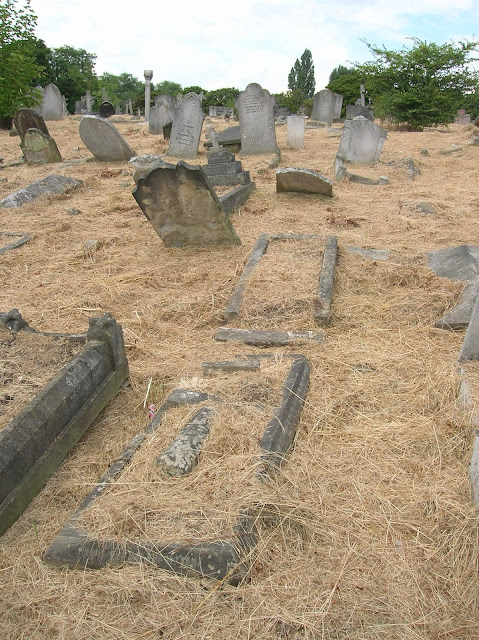
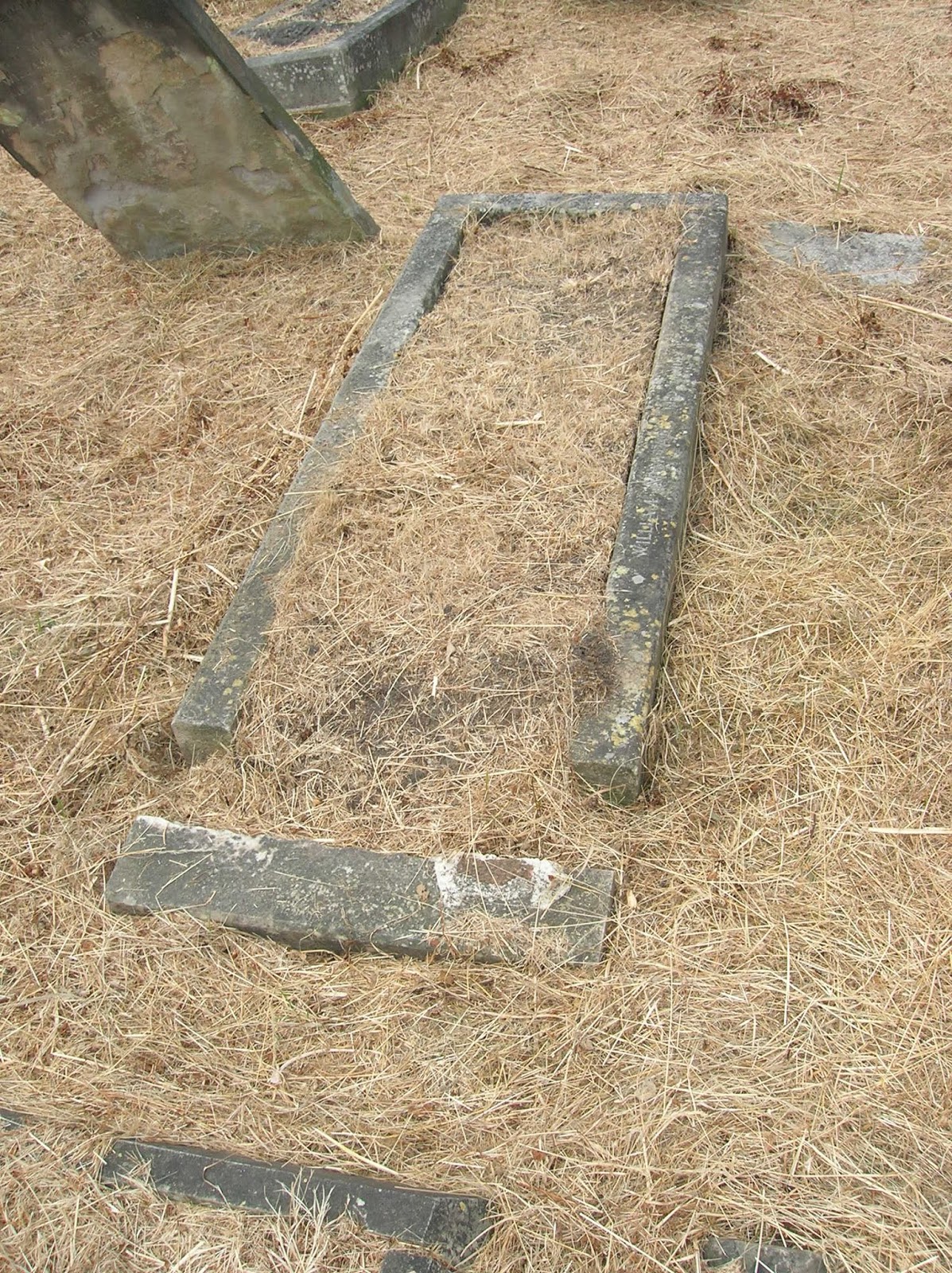
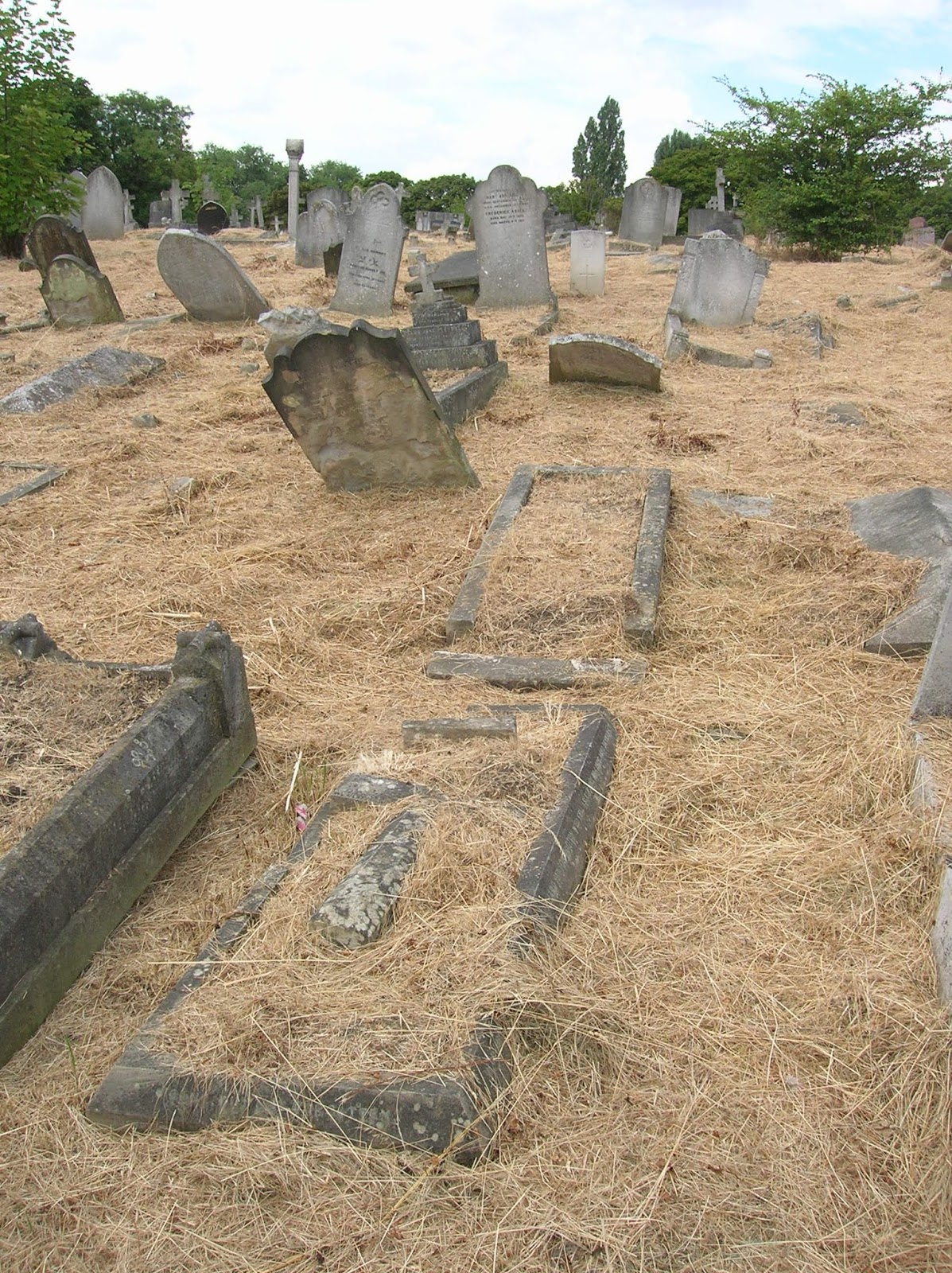
cemetery is large so it took me a while to walk to square 123. I was
able to locate William’s grave by comparing the names on gravestones with those
on my detailed plan. William was not a wealthy man, so I was not surprised to
find that his grave monument is a simple one. It is inscribed “WILLIAM ARMITAGE
died 7th July 1926 aged 85”.

Grave
inscription
William’s grave
William’s grave
and those around it.
Monday, 20 November 2017
Angelina Fildes nee Armitage (1868-1949): Tried at the Old Bailey
Angelina
Armitage was born in 1868 in Saltash (near Plymouth), Cornwall. She was the
second of seven children born to Edward Armitage and his wife Mary nee
Willcocks. Edward (1839-1880) was an elder brother of my great grandfather
Robert Melton Armitage (1846-1910). A profile of Edward’s life is on this blog.
Angelina was a cousin of my grandmother Emma Ivall nee Armitage (1883-1970).
Angelina’s
family moved to London in late 1870 / early 1871. The 1871 census shows Edward,
aged 32, a police constable, living in Tottenham with his wife Mary (34) and
children Angelina (3) and Thomas (7 months). Around 1875/6, Edward and his
family moved to Hackney. In 1880, Edward died suddenly from a ruptured blood
vessel, when Angelina was aged 12.
The
1881 census shows Edward’s widow Mary (aged 43, a laundress) with her children
John (6) and Ernest (2) living at 5 Gainsboro Square, Hackney. His daughter
Angelina (aged 13) was an orphan scholar at Cumberland House Orphanage,
Greenleaf Lane, Walthamstow.
Angelina
married Stuart Gladstone Fildes on 20 June 1889 at St Mary the Boltons Church,
Kensington.

From the
church marriage register
I wonder if they got married without telling their
families, as the witnesses were not family members ?
Stuart
Gladstone Fildes was born in Chorlton, a suburb of Manchester. He is shown in
the 1881 census aged 13, the only child of Thomas Fildes (41), a member of the
Manchester Stock Exchange, and his wife Jessie Macblane Fildes nee Mackie (32). They
were living at a house called Fairlawn in Lytham, Lancashire. Also listed at
the address were a butler, a cook, a kitchen maid, two housemaids, a nurse, two
grooms and a coach man. Thomas Fildes died in 1887 aged 47. His personal estate
was declared as £25,660 for probate purposes. This is equivalent to about
£12,000,000 now (estimated in relation to the earnings index). The house
Fairlawn was advertised for sale after his death. It was clearly a large
property with 4 entertaining rooms, 11 bedrooms, stabling for 8 horses and 4
acres of grounds. Thomas was a wealthy man! His widow married Edmund William Birley in
1888.
It
is perhaps surprising that Stuart, a man from a wealthy family, married
Angelina, who was from a lower social class and must have been quite poor. They
set up home at 15 Redcliffe Street, South Kensington but the marriage was not a
success and Stuart left Angelina on 7 October 1889, only 15 weeks after their
marriage. Angelina asked him to return but he refused. Later that year she
applied to the courts for “restitution of her conjugal rights”. Such a case could be brought against a husband or wife who were living away from their spouse without a good reason. If the suit was successful, the married couple would be required to live together again. The case papers
can be read on the Ancestry website. The Lichfield Mercury dated 7 November
1890 reported the outcome of the case (Angelina was the petitioner and Stuart
the respondent).
A PRESTON MATRIMONIAL CASE.
The case of
Fildes v Fildes was heard in the Divorce Court. It was a suit instituted by the
wife, praying for the restitution conjugal rights. Mr. Middleton, who appeared
for the petitioner, said the parties married on the 28th June, 1889, and after
that they lived for some time in Redcliffe Street, South Kensington. The
respondent, on the 7th of October last year, left the petitioner, and went to
his mother's house at Preston. In the following November there was an interview
between the husband and wife, and on the 5th of last December the petitioner
went down to Preston and delivered into the hands of her husband the final
notice required before the suit for restitution could be commenced. Upon its
being served, the respondent disappeared, after which application was made for
substituted service. There was an appearance under protest, but it was
overruled by the learned President of the Divorce Division. The petitioner said
that when she married Mr. Stuart Fildes she believed him to be a gentleman of
independent means. On 7th of October last year he left home and she had never
lived with him since. The last time she saw him she asked him to return to her,
but he refused to so.
Mr. Justice
Butt: What reason did give for leaving you?
Petitioner: He
never gave any.
Mr. Justice Butt
granted a decree as prayed.
Stuart’s
disappearance was presumably an attempt to avoid allowing the suit to progress.
“Substituted service” is the indirect delivery of legal documents to request an
individual's presence in court. Stuart did not defend the case and costs were
awarded against him.
Even
though Angelina won the case, her husband did not return to live with her. In the 1891
census there is an Angelina Fieldes, aged 23, born in Cornwall, living in
Cadogan Terrace, Hackney. Her occupation is described as “living on own means”.
Also listed with Angelina is Robert E A (the
initials are unclear) Fieldes, a son aged 3, born in Hackney. There are no
Robert Fi(e)ldes birth registrations that match this. The best candidate that I
can find is a Robert Herbert Ernest Armitage birth registered Q4 1887 in
Hackney. There is no mother’s maiden name registered with this birth,
indicating that the mother was unmarried. I can find no marriage or death for
this person and he does not appear with Angelina in any later records. Perhaps
he was born to Angelina before she married and later given up for adoption?
This is speculation on my part.
The
1891 census shows Stuart living as a boarder at Dyffryn Aled, Llansannan,
Denbigh. This was a 25 bedroom house on remote moorland in North Wales. It
sounds like he may have been in hiding to avoid complying with the court order.
Electoral
registers show Angelina at 1 Kings Court Mansions, Fulham Road, London in 1900.
The census in 1901 shows her aged 33, living alone in High Street, Yoxford, a
village in Suffolk. Stuart was a visitor at a guest house in Sidmouth. The occupation
for both was “living on own means”.
There
were dramatic events in 1909. The item below was printed in The Barnet Press
dated 29 May 1909.
SOLICITOR AND LADY
Exciting Interview.
Last week, a
well dressed woman called at the London offices of Mr Charles Henry Cumberland,
solicitor, who resides at The Firs, Bell Bar, Hatfield, and the interview took
such a dramatic turn that the woman was charged before Mr Curtis Bennett at Bow
Street Police Court with threatening to murder Mr Cumberland, and with
unlawfully presenting a revolver at Police Constable McDonald, with intent to
do him grievous bodily harm.
The woman, who
gave her name as Angelina Fildes, declined to state her age, or give her
address. Mr Cumberland was called on by the police to give evidence. He said he
did not think it expedient to charge the defendant himself, as he did not
consider that she was responsible for her actions. About 20 years ago he acted
for the trustee of a settlement in which she was interested, and, under their
directions, he paid her a regular allowance for about two years. The matter
then passed out of his hands, and he had not seen her or had any communication
with her from that time until the previous day, when she called his office by
appointment. The trustees of the settlement had recently asked witness to act
for them again, and that was why the defendant called at his office on Friday.
When she entered witness said to her: “I presume you have come to give me
instructions as to the mode of paying your allowance from the trustees?” She
replied, “I have no instructions to give, and I will not be under your thumb
again”. Witness told her that he had been instructed make certain payments to
her, and he wished to meet her convenience in every way. She had previously
been receiving her money direct from the trustees. Defendant said she would not
have an allowance and demanded her husband’s address. Witness said he must
decline to give it to her. Thereupon she left the chair in which she had been sitting,
took two or three steps backward, and produced a revolver, which she pointed at
witness. With the weapon held in that position she said: “I am a desperate
woman, and I not going leave here until I get my husband's address.” Witness
still refused to give it, and the defendant said: “You won’t?” In order to
temporise, witness asked the defendant if she would be satisfied if he asked
her husband to meet her at his office; but he did not catch her reply. He then
called over the telephone his clerks’ office and asked them to go for the
police. The defendant heard him, and said sarcastically: “Oh, I did not think
you would have been so kind.” She remained leaning over the back of a chair,
pointing the revolver at witness until P.C. McDonald entered. On seeing the
revolver the officer said to her: “Put that thing down.” The defendant said:
“Who are you talking to?” At the same time she turned the revolver towards the
constable, who made a sudden rush and seized her by the hand. At that moment
the revolver went off and the bullet entered the office wall. The defendant was
then arrested.
The Magistrate:
Have you any questions to put to this witness?
Defendant: No; I
refuse to be under his thumb. He will allow me the income as long as he thinks
proper, and then he will stop it.
Witness: I have
no discretion
The defendant:
You have. It is a discretionary allowance.
Witness: It is
discretionary so far as the trustees are concerned. I have no discretion.
The defendant:
For 19 years you have been my bitterest enemy. Nineteen years ago you did me a
deadly wrong. Understand that.
P.C. McDonald
said he did not actually seize the defendants hand when she refused to comply
with his request to put the revolver down. He rushed towards her and knocked
her hand up and at that moment the revolver went off.
Inspector Bailey
said the revolver was loaded in four chambers, and contained one empty cartridge.
When the charge was read to the defendant at the police station she said: “I
did not resist at all. As regards Mr Cumberland, I meant it.”
The defendant
was remanded.
Angelina was held in Holloway Prison and her case was heard at the Old Bailey on 23 June 1909. “The Proceedings of the Old Bailey” website contains
the court’s official record and says
FILDES, Angelina
(41, no occupation), indicted for feloniously attempting to discharge a loaded
revolver at Charles Henry Cumberland, with intent to do him grievous bodily
harm; assaulting and resisting William McDonald, a Metropolitan
police-constable, in the execution of his duty, pleaded Guilty of a common
assault on Cumberland; Not guilty of assaulting the police-constable or of
firing the pistol.
Prisoner has
been in prison five weeks, during which time she has been under observation.
The doctor reports that her mental condition is somewhat unstable, perhaps, and
she seems to have been brooding over more or less imaginary wrongs; but she has
undoubtedly benefited by her detention.
The
case was reported by various newspapers including the Exmouth Journal. The
edition dated 26 June 1909 reads
WOMAN WITH REVOLVER
Angelina Fildes,
the woman who presented a revolver at Mr. Cumberland, a solicitor, in his
office near Bedford Row the other week, was brought up at the Old Bailey on
Wednesday charged with unlawfully resisting P.C. McDonald. The weapon was
discharged as the constable was about to arrest Fildes.
Mr. Morris, for
the defence said the prisoner was married in 1889, and five months later her
husband left her, and she had not seen him since. She had received £8 10s
weekly under trust in which Mr. Cumberland acted and she gained the impression
from a letter written by him that the amount was about to be reduced. Her
intention in going to the office with the pistol was to draw attention to her
life, for she had been living an utterly lonely existence in little villages.
She was prepared to promise to communicate with Mr. Cumberland only by letter
in the future, and go to live with some friends at Brighton.
The Judge
ordered her to be bound over in her own recognisances on the understanding that
this course was taken.
Another
paper reported that
During the
hearing of the case, Mrs Fildes screamed and fell to the ground, being carried
out hysterical.
Angelina’s
weekly allowance of £8 10s in 1909 is equivalent to about £3,200 now, when
related to the earnings index. This figure and the description of her as a
“well dressed woman” in the report of her appearance at Bow Street Police Court
indicate that Angelina was comfortably off.
In
the 1911 census, Angelina (aged 43) and her mother Mary (73) are shown as visitors
at 11 Denbigh Terrace, Notting Hill, the house of Angelina’s cousin Thomas
William Armitage (39). I can’t find Stuart in the census.
The 1921 census shows Angelina (aged 52, married) and her mother Mary (83, widow) as visitors in the house of Angelina's sister Mary Armitage (54, single, a lodging house or apartments keeper) at 48 Cambridge St, near Victoria Station in London. Her estranged husband Stuart was living in Malvern, Worcestershire.
Angelina’s
elder sister Mary Emma Armitage died in 1925 aged 60 at St Thomas’s Hospital,
Lambeth. Probate records give her address as 48 Cambridge Street, Victoria and show that administration of her estate (£341) was
granted to Angelina Fildes.
Stuart
Fildes of Madresfield Road, Malvern is listed as a dog breeder in the 1932 Kelly’s
Directory of Worcestershire. His mother Jessie Macblane Birley died in 1938
aged 89. Her last address was Malvern Hotel, Malvern. Probate on her estate (£1,392)
was granted to Stuart Gladstone Fildes, no occupation.
The 1939 Register shows Angelina living at "The Gables" in the Truro registration district (in Cornwall). Her date of birth is given as 14 Feb 1870 (the year was actually 1868), her occupation as "unpaid domestic duties". She is listed as married (so there had been no divorce from Stuart).
Angelina
died on 26 November 1949 aged 81. Her address was The Gables, Perranporth,
Cornwall. Angelina’s name appears in the burial register of Perranzabuloe
Church (near Perranporth), so she is presumably buried in its churchyard.
Administration of her estate (£2,748) was granted to Barclays Bank.
Stuart
died in 1950 aged 82. His address was 45 Madresfield Road, Malvern
and he died at Clanmere Nursing Home, Malvern. Stuart is buried at Great
Malvern Municipal Cemetery and his gravestone is inscribed “Stuart Gladstone
Fildes, born 18 Jan 1868, died 15 Dec 1950.” Probate records show that his
estate was valued at £30,563.
Tuesday, 14 November 2017
The Funeral of Edward Armitage (1839-80)
Edward Armitage was an elder brother of Robert Melton
Armitage (1846-1910), my great grandfather.
Funeral of a Police Constable
A much respected
member of the Hackney Division of Police (Edward Armitage, 547), died rather
suddenly in his garden, on the 6th inst., from rupture of a blood vessel, and
on Tuesday the final obsequies were observed at the Manor Park Cemetery. The
cortege, which started from the deceased's late residence, 26, Pratt Road,
Clapton Park, consisted of hearse and mourning coach and the mourners included
four inspectors, 11 sergeants, 110 constables; the Band of the Division and four
officers of the Volunteer Fire Brigade, with engine also being present, and
attracted considerable attention en route. The ceremony was a most impressive
one, the officiating divine deducing from the sad event the awful uncertainty
of life. The deceased, who leaves a widow and seven children, had fortunately
taken the precaution of insuring himself and family in a society which very
many of the men of the N and other divisions have also joined, viz., the Royal
London Friendly Society, and thus spared the bereaved ones the pangs of poverty
which invariably follow the demise of the improvident husband and father. There
are certainly benefits to be derived by the families of deceased P.C.’s., still
too much provision cannot made to enable a widow with a family to meet the
stern realities of the world; and the above painfully sudden case should prove
a stimulus to others to make a like provision.
Cemetery records show that Edward was buried in Manor Park
Cemetery grave 100/328, which is shared with three other people not related to
him.
A revised profile of Edward's life is on this blog.
Monday, 23 October 2017
George Henry Armitage : International Cap
My great uncle George Henry Armitage (1898-1936) played football for Charlton Athletic FC (see the item about his life on this blog). He was selected seven times to play for the England amateur team and once for the England professional team. I have donated one of his England amateur international caps, which was awarded for the match against Wales in the 1923-24 season, to the Charlton Athletic museum. They were pleased to receive it and tell me that they intend to display it at the museum.


One of George's caps, similar to the one donated.
Thursday, 14 September 2017
Armitage photos
Cheryl, a great granddaughter of Robert Melton Armitage (1874-1953), has seen this blog and kindly supplied me with photos of him, his wives and children. I have added them to the items on Robert and his son John James William Armitage (1906-41).
Saturday, 9 September 2017
My Armitage / Pinnuck Family History Blog Statistics
I
started my Armitage / Pinnuck family history blog in 2012 and have now posted a
total of 30 items (including this one). The blog is published using Google
Blogger, which provides statistics on the number of people who have looked at
it.
The
total number of page views so far is 10,526, a respectable number. The largest
number of page views came from Germany (2,443) followed by the UK (2,280),
Russia (1,772), United States (1,422) and Australia (492). Why my blog has been
viewed in Germany and Russia is not clear to me.
Items
with the most page views are:
888
: George Henry Armitage (1898 - 1936), international footballer
747
: Robert Melton Armitage (1920-1993), train driver
362
: Stanley Thomas Armitage (1925-94), British Rail clerk
350
: Alfred George Armitage (1918-91), signalman and station master
346
: Robert Melton Armitage (1846 - 1910), milk carrier
252
: Gertrude Ellen Bull nee Armitage (1889 - 1978)
185
: William Armitage (1841-1926), soldier and gatekeeper
142
: David Pinnuck (1837-1922) and Edward George Pinnuck (1843-1927), immigrants
to Australia
86
: John James Armitage (1881-1953), decorated soldier
62
: William Frederick Armitage (1884-1940), warehouseman
Several
people have seen my blog and contacted me with additional information and
pictures, which I have added to the appropriate items.
Subscribe to:
Posts (Atom)