Tuesday, 6 December 2022

Ernest Henry Armitage (1879-1942)

Ernest was the youngest child of Edward Armitage (1839-80), who was an elder brother of Robert Melton Armitage (1846-1910), my great grandfather. There is an article about Edward’s life on this blog. Edward’s children were first cousins of my grandmother, Emma Ivall nee Armitage (1883-1970).

Ernest’s birth was registered in Q1 1879 in Hackney. There are no other Ernest Henry Armitage births in FreeBMD. His father Edward (then a police constable) died in 1880, when Ernest was aged 1. The 1881 census shows Edward’s widow Mary (aged 42, a laundress) with her children John (6) and Ernest (2) living at 5 Gainsboro Square, Hackney.

I can’t find Ernest in the 1891, 1901, 1911 or 1921 censuses. However, he is listed in Metropolitan Police records as a Constable (warrant number 91064) who joined on 5 Sep 1904 and left on 20 May 1919.

Freemasonry records show that Ernest, a Constable in the Metropolitan Police, was initiated into the Carnavon Lodge, Havant on 1 Oct 1912 age 33 and continued to pay his annual subscription there until 1921.

Ernest married Frances Carey on 1 Jun 1913 in Southsea.

The First World War began in August 1914. Ernest volunteered to join the army on 23 Apr 1915. He gave his address as 8 Peel Terrace, Stoke Road, Gosport and his occupation as motor lorry driver. He was assigned to the Army Service Corps, 268 Company and was sent to France arriving on 21 Jul 1915. Ernest was seriously injured in an accident on 8 Mar 1917 and invalidated to the UK on 12 Mar 1917. A Court of Enquiry into the accident decided that Ernest was in no way to blame. Ernest was sent back to France after he recovered and demobilised on 10 Feb 1919. He was assessed as 5% disabled and assigned a payment of 6s a week. He gave his address for this as 48 Cambridge St, Victoria, which is where Ernest’s sister Mary Emma Armitage lived.

Ernest married again in 1924. His second wife was Elizabeth Jones and they were married in Steyning (in Sussex). Electoral registers show them living at 58 Woodville Road, Hendon between 1929 and 1934. In 1938 and 1939 they were at 636A Finchley Road, Hendon. Birth records indicate that Ernest did not have children with either of his wives.

I can’t find Ernest in the 1939 register. He died in 1942 in Hendon aged 63. He doesn't seem to be listed in probate records.

Wednesday, 19 October 2022

Car crash involving George Henry Armitage

George Henry Armitage (1898-1936) was a passenger in a car that collided with a tram in May 1935. One of the other passengers (Florence E Beale, aged 36), died in the accident. The following item was published in the Reynold's Newspaper (5 May 1935) :


This incident must have been upsetting for all those involved in it. Perhaps it was one of the factors that resulted in George's suicide "while of unsound mind"  some 15 months later in August 1936.

Thursday, 3 February 2022

Frances Elizabeth Weiste nee Paul (1874-1959)

Frances was a cousin of my grandmother Emma Ivall nee Armitage (1883-1970). The mother of Frances was Sarah Sophia Paul nee Pinnuck (1854 – 1916), who was an elder sister to Ellen Armitage nee Pinnuck (1855-1913), Emma’s mother. 

Sarah Sophia Pinnuck married Luke Paul on 8 June 1873 at St Andrew’s, Enfield. She was aged 19, he was 27, a labourer. Their only child, Frances Elizabeth Paul, was born on 3 February 1874 in Enfield. Luke joined the Metropolitan Police in 1875.

The 1881 census shows Luke (aged 34, born in Thetford, Norfolk, a police constable), Sarah (26, born in Enfield) and Frances (7, born in Enfield) living at 34 Catherine Street, St Paul Covent Garden, Strand in London. Also listed at the address were Luke’s brother William Paul (30) as well as Sarah’s brothers Alfred (18) and George (14) Pinnuck.

In 1891 Frances (aged 17, a milliner’s apprentice) was living at 3 Tenison Street, Lambeth, which was a lodging house run by her mother. Also listed at the address were Frances Pinnuck (67), mother of Sarah. There were 8 lodgers (including 3 actresses) staying there. Tenison Street no longer exists. Its site (near Waterloo Bridge) is now occupied by the Hayward Gallery. The census shows that Luke Paul (44) was a patient in Charing Cross Hospital. He left the Metropolitan Police in 1896 and moved to Hitchin, Hertfordshire with his wife Sarah, where he ran The Highlander pub, 45 Tilehouse Street.

Frances Paul married Diedrich Franz Felix Weiste on 9 January 1899 at St Mary’s Hitchin. She was aged 25, he was 28. He was born in 1871 in Tulse Hill, Lambeth. He is listed in the 1881 census, living in Beckenham with his father John Diedrich Weiste (aged 44, a warehouseman, born in Germany), mother Clara (38, born in Germany) and siblings aged 12, 11, 7 and 1, all born in London. Diedrich was initiated into the Freemasons in 1898, when his occupation was “manufacturer’s agent”.

Frances and Diedrich had a daughter Helene Clara Selma Pauline, born 22 November 1899. She was baptised at Holy Trinity, Penge on 3rd February 1900. The record shows the family’s address as 29 Honley Road, Catford and Diedrich’s occupation as manufacturer’s agent. They had a second daughter, Dorothea Eileen W, born in January 1901. The 1901 census shows the family (with a domestic servant) living at 65 Byne Road, Sydenham, a pleasant suburb of South London.  The house still exists and looks to be quite spacious.

In 1911 the family, still living at 65 Byne Road, consisted of Diedrich Weiste (aged 40), Frances (37), Helena (11) and Dorothea (10). Diedrich’s occupation is hard to read, but it seems to be “Rope turner, yarn and mat agent”. He is shown as an employer. The house had 7 rooms. Also listed was Frances Pinnuck (18). She was a daughter of Alfred Pinnuck, Sarah Paul’s brother. Alfred died in 1897 and his wife Harriett died in 1901, so Frances Pinnuck was an orphan. She had gone to live with Sarah and Luke Paul in Hitchen in 1901 and married George Henry Kemp in 1914. An item about the life of Frances Elizabeth Kemp nee Pinnuck is on this blog.

The 1914 Kelly’s Directory for London lists Diedrich Weiste & Co, Twine and mat agents, 30 Little Trinity Lane, City of London. Electoral Registers indicate that Diedrich and Frances were living at Blair Gowrie, South Benfleet (a village in Essex between Basildon and Southend-on-Sea) between 1918 and 1922. The 1921 census shows the family living at this address, which had 7 rooms. Those listed in the household were Diedrich (aged 50), Frances (47), Helena (21) and Dorothea (20) Weiste, also Ethel Mott (27, a domestic servant) and Gladys Mott (4). Diedrich and Frances are both shown as manufacturer's agents, with their place of work being 30 Little Trinity Lane.

Electoral Registers show that Deidrich and Frances moved to Orchard House, Oak Road, Green Street Green, Farnborough, Kent in 1923. This is now in the Borough of Orpington, on the SE edge of London. Deidrich’s business address changed to 63 Queen Victoria Street in 1925.

A 1930 passenger list shows Dorothea Weiste, aged 29, on board a ship travelling from Liverpool to Rangoon in Burma. It gives her occupation as lecturer and says that she intends to reside in Burma. I can find no more British records relating to Dorothea, so it seems that she did not return to the UK. Burma was a British colony until 1948.

The 1938 Kelly’s Directory shows that Frances was running a shop (listed under Domestic Stores) at 1 The Parade, Poverest Road, St Mary Cray, Orpington.  

The 1939 Register shows Diedrich (born 17 March 1871, a twine and carpet manufacturing agent), Frances (born 3 February 1874, a shop manager) and Helena (born 22 November 1899, a shop assistant) living at Orchard House, Oak Road.

Diedrich died on 27 January 1955 aged 83. Probate records give his address as Orchard House, Oak Road. He left £933 and the executor was his daughter Helena, who was a spinster. Frances died on 9 January 1959 aged 84. She had the same address and executor, the estate was £319.

Helena died on 7 February 1985 aged 85. She was living at Isard House, Glebe House Drive, Hayes and left £53,415. I don’t have a record of Dorothea’s death.

Tuesday, 22 September 2020

Photo of Frances Elizabeth Kemp nee Pinnuck

This blog contains an item on the life of Frances Elizabeth Kemp nee Pinnuck (1892-1930). Her great grand-daughter Val has recently found a new photo of her, which she has kindly sent me.

The photo, taken in 1915, shows Frances with her first child Elsie Lilian Kemp.

Thursday, 2 August 2018

Patrick James Armitage (1926-2018)

Patrick James Armitage was a grandson of William Armitage (1841-1926), who was a brother of my great grandfather Robert Melton Armitage (1846-1910). The information about Patrick’s life comes from the eulogy written by his daughter Joanna for his funeral this year.

Patrick was born on the 7th of August (his mother’s birthday) 1926 in Colchester, Essex. His father was John James Armitage (born 1881), a retired officer in the Royal Artillery. His mother was Clara Margaret Armitage nee Moss (born 1891), a trained tailoress. When Patrick was born he had a sister Clara (12), and a brother John, known as Jack (10). Patrick’s mother was one of 9 siblings so Patrick was always spoilt by the family. His mother’s youngest sister, Auntie Ivy, was his favourite.
Patrick with his mother Clara c 1928

Patrick’s father was a soldier who joined the Royal Field Artillery in 1900 and later served in South Africa and India. He fought in the First World War and was awarded the Distinguished Conduct Medal, was Mentioned in Dispatches three times as well as being injured at least twice. He was promoted to Second Lieutenant in 1915 and retired from the army in 1920 with the rank of Captain. Patrick’s brother Jack gave up a good career as a design engineer and according to Patrick “ran away to war“, going to Palestine, Egypt, India and other interesting places. Even when he was at school, Patrick desperately wanted to follow his father and brother and join the Army. His father sent him to Colchester High School, and being in a garrison town, he spent a lot of time surrounded by the military. On getting his first bicycle, he was able to bike through the garrison every day rather than taking the bus to school !

Patrick’s family moved to Worcester, where his father worked for the Sandeman port and sherry company. Patrick went to school there. Later his father was appointed as district manager for the Eastern Counties and Midlands region and the family moved back to Colchester in about 1935. Patrick remembered a happy childhood in Colchester and Worcester doing lots of things with his mother such as going to the cinema, tea rooms, pantomimes, visits to the Essex coast, picnics and watching the troops parade in the Lower Castle Gardens on a Sunday after church. His mother was very important to him, however, larger influences in his environment formed his future. He joined the Local Defence Volunteers, later known as the Home Guard, and was a very active member during his school years. He also joined the Air Training Corps, learnt about planes and how to navigate. He became a motorbike dispatch rider, meeting the Duke of Kent before he was killed in a plane crash.

At school Patrick was taught how to dress smartly, present himself well and how to behave. These early lessons stood him well when he finally entered the army. Throughout his life, Patrick was a gentleman, well turned out, with short-back-and-sides, ready for parade. Patrick left school at 16, apparently “because he was wasting his time and his father’s money” and had various jobs such as bicycle mechanic. He then started as an apprentice laboratory technician at Colchester Hospital, but because it was a reserved occupation, vital for the war effort, he did not get his call up. Therefore he resigned and worked as a meter reader, which got him his long desired papers! Like his father, he joined The Royal Regiment of Artillery and in 1946, at the age of 20, he was stationed in Germany, near Kiel. Sixty years later, as an 80th birthday present, he revisited the area, finding places he had seen as a young man.
Patrick in his army uniform

Patrick met Julia Ann Todd-White, a midwife, in Colchester and they married in 1956. They had two children, a girl and a boy, who were born in Colchester. Patrick worked for Sandeman, a position he took over from his father, living in Lexden, a suburb of Colchester. In 1963 he moved to Fyfield, Essex and in 1971 the family moved to Framlingham, Suffolk. Patrick worked for various companies in the wine trade, retired from Adnam’s, and spent the rest of his life in this old market town.
Patrick in later life

Patrick loved driving, cars and travelling. He had many European trips with friends to Belgium, France, Germany, WWI and WWII memorial sites with yearly visits to Switzerland to see his family and grandson.

After Julia’s death in 2015, Patrick moved into the newly renovated Mills Meadow care home in Framlingham, where he thrived and blossomed with all the attention of the staff, the excellent food and wine and regular church services. He enjoyed visiting friends from the community and his new friends in the care home, in particular, Joan, a lady 10 years his senior, with whom he found many things in common to discuss.

At the end of 2017 Patrick developed a lung infection, was admitted to Ipswich hospital and when he returned to Mills Meadow he had lost all his strength to sit and ride around in his electric wheelchair. Unfortunately Patrick did not recover from the setback of Joan’s death and further infections. He died in Framlingham on April 14th 2018 aged 91. His funeral service was held at Ipswich Crematorium.

Thursday, 26 July 2018

More Armitage photos

I have added photos of William Armitage (1841-1926) and John James Armitage (1881-1953) to the items about their lives on this blog. The photos were kindly supplied by John's grand-daughter Joanna.

Tuesday, 17 July 2018

Finding the Grave of William Armitage (1841-1926)

This blog contains an item on the life of William Armitage (1841-1926) a soldier, who later became a gate keeper in Kensington Palace Gardens. The website Deceased Online lists a burial at Kensal Green Cemetery which seemed likely to be his. The burial register gave the grave number as 48425 and I decided to visit the cemetery to look for the grave.

The following information comes from the website of The Friends of Kensal Green:

The General Cemetery of All Souls, Kensal Green, is one of England's oldest and most beautiful public burial grounds, and certainly its most prestigious. One of the world's first garden cemeteries, and doyen of London's Magnificent Seven, Kensal Green received its first funeral in January 1833, and still conducts burials and cremations daily. The cemetery was innovative in having most of the site consecrated by the Church of England, but reserving the eastern spur for Dissenters and others to practise their own rites. Today, people of many faiths and denominations are buried throughout the cemetery. Uniquely among British cemeteries, Kensal Green has been managed by the same private joint-stock company since its inception: the General Cemetery Company (est. 1830) still has its offices by the Main Gate. The cemetery now covers some 72 acres (29 hectares) between the Grand Union Canal and Harrow Road in west London, and is open to visitors every day of the year.

Many famous people are buried in the cemetery. Its notable personalities include some 650 members of the titled nobility and over 550 individuals noted in the Dictionary of National Biography. Kensal Green is the resting place of the engineers Sir Marc Isambard Brunel and Isambard Kingdom Brunel, the mathematician Charles Babbage, and the novelists Wilkie Collins, Anthony Trollope and William Makepeace Thackeray; Lord Byron's wife, Oscar Wilde's mother, Charles Dickens' in-laws and Winston Churchill's daughter; a cross-dressing Army doctor and the surgeon who attended Nelson at Trafalgar; the creator of Pears' Soap, and the original WH Smith; the funambulist Blondin and the Savoyard George Grossmith; the first man to cross Australia from south to north; and the last man to fight a duel in England.

The graves are not arranged in order of their numbers, so I visited the cemetery office to ask where grave 48425 is located. The man there was very helpful. He looked up the grave in the cemetery register. The entry showed that the burial rights were purchased on 9 July 1926 for £10:10 by Ellen Elizabeth Armitage of 225 Cornwall Road, Notting Hill. This was the name of William Armitage’s daughter, thus confirming that the grave was that of my relative. The burial took place on 12 July 1926. A monument, described as “marble kerbs on concrete ledge” was place on the grave on 24 March 1927. Grave 48425 is in Square 123, Row 4. The entry showed that no other people are buried in this grave.

The man in the office gave me a cemetery map showing the location of square 123 and directions on how to get there. He explained that newer graves in the cemetery often have a code on them such as 65234.110.2, which corresponds to the grave number.square.row. This is helpful in locating the square that you are looking for. He also gave me a detailed plan showing the positions of graves within square 123, with the surnames of those buried in them.
Cemetery map


Plan showing graves within square 123

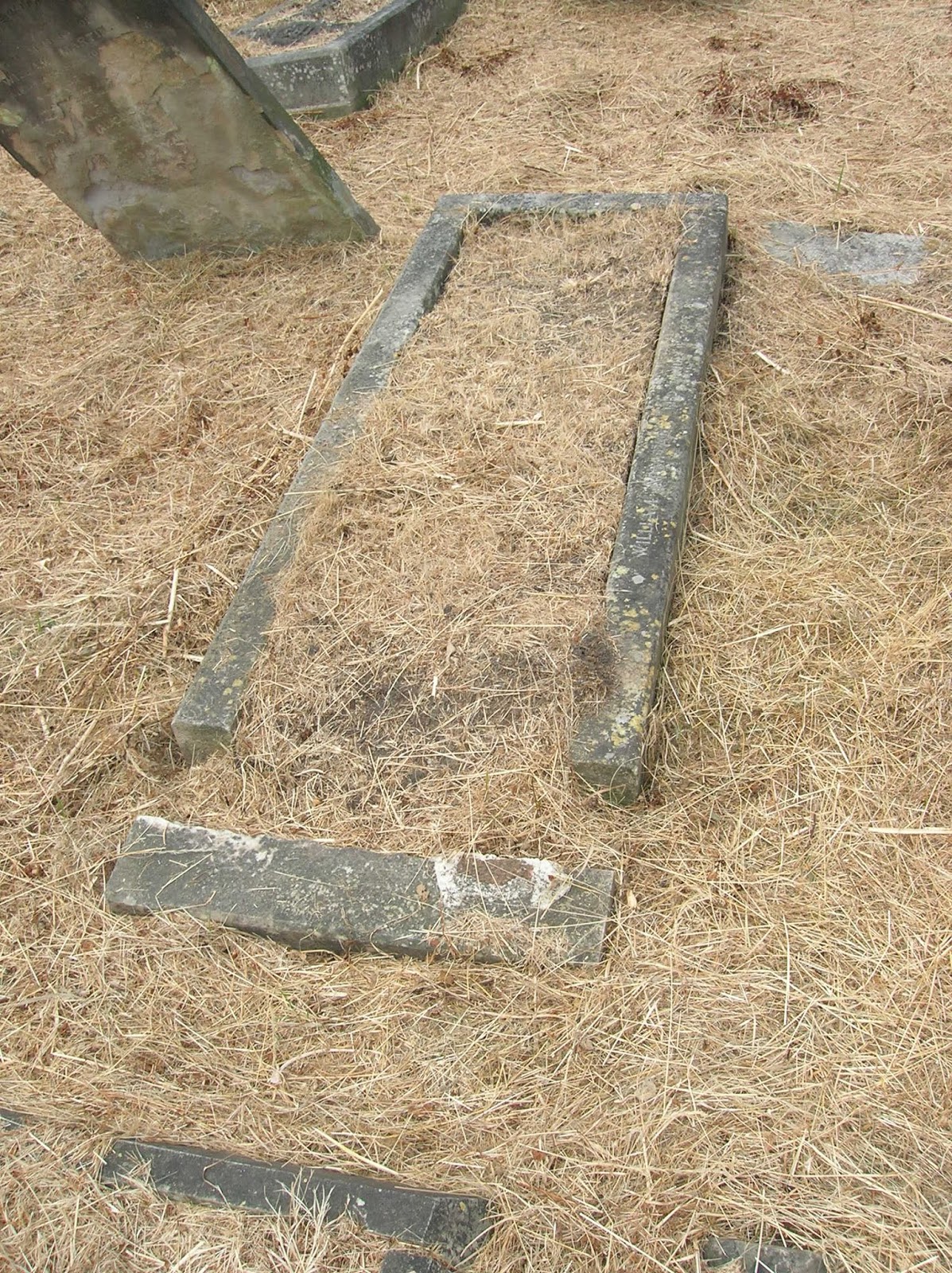
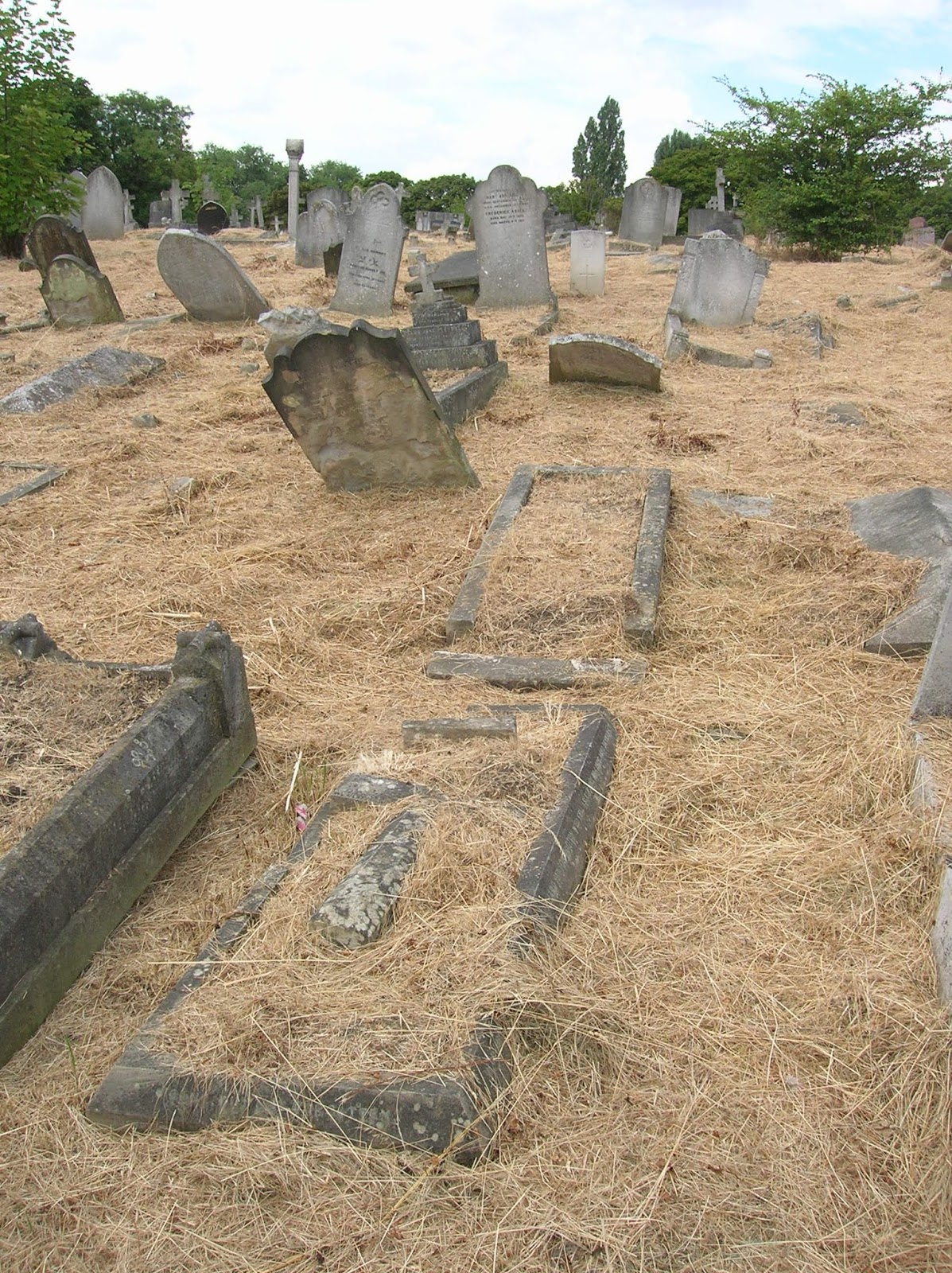
The cemetery is large so it took me a while to walk to square 123. I was able to locate William’s grave by comparing the names on gravestones with those on my detailed plan. William was not a wealthy man, so I was not surprised to find that his grave monument is a simple one. It is inscribed “WILLIAM ARMITAGE died 7th July 1926 aged 85”.

Grave inscription

William’s grave

William’s grave and those around it.